Mauli Ola Cards

Learn at home with your ʻohana!
About Our Mauli Ola Cards

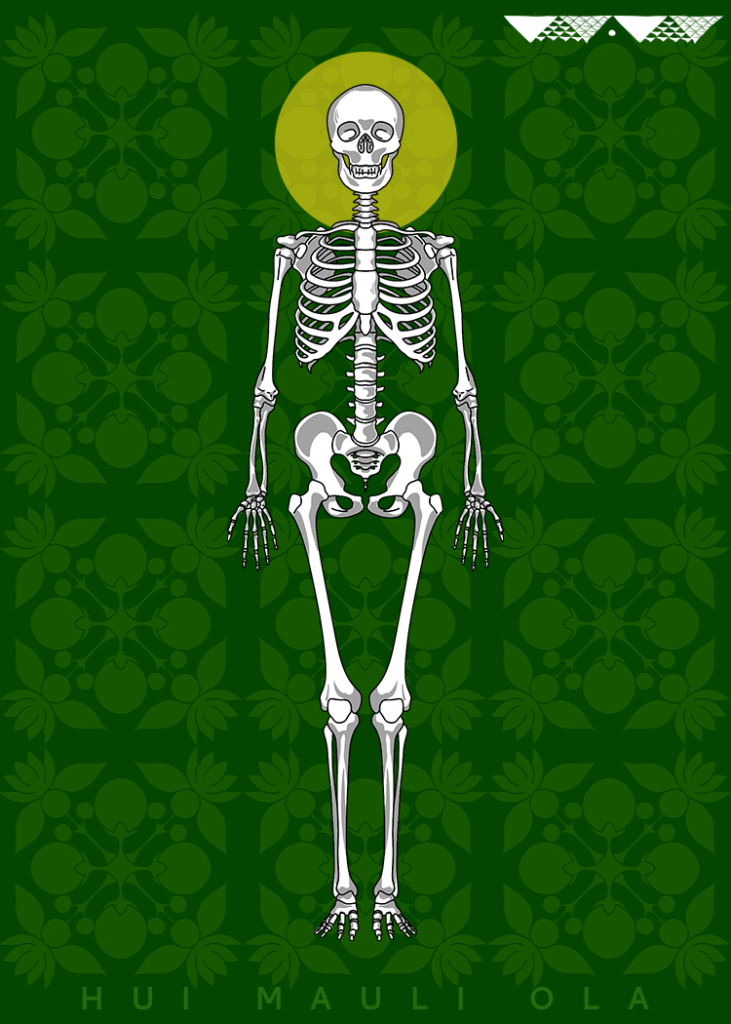
Mauli Ola Cards are an interactive resource designed to share healing ʻike with our community. Featuring the Hawaiian and scientific names of muscles and bones, these cards support both beginners and experienced practitioners in deepening their learning and practice.

Artwork: Kalilinoe Detwiler
ʻIke: Judd, G. P. (2003). Anatomia, 1838 (Hawaiian text with English translation). University of Hawaiʻi Press.
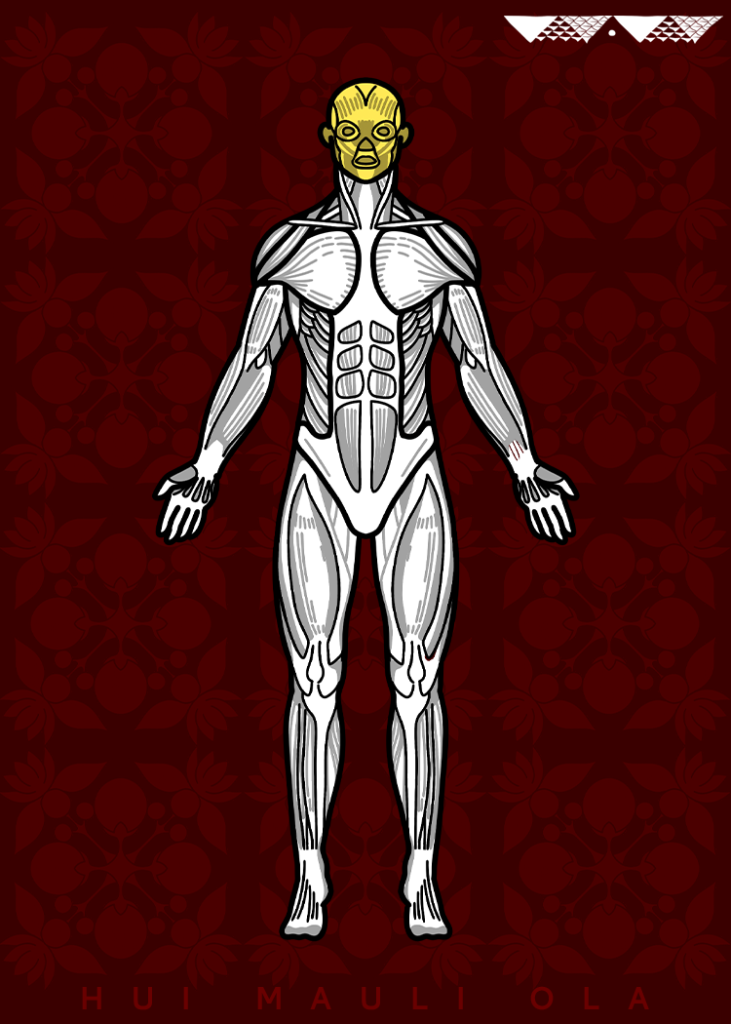
ʻIʻo

Muscles

Head

Iwi

Bones

Head
About the Artist

Kalilinoe Detwiler

Kalilinoe Detwiler is a Kanaka Maoli artist-writer who grew up watching the clouds move across Oʻahu from her home in Makakilo. Her work cares for the adaptation of lives, strengthening of relationships, coming of age narratives, and perpetuation of inherited moʻolelo (stories, histories) using creative, often hybrid forms. Woven into her practice as a storyteller are reciprocity, hope, and sovereignty, and her preferred mediums include poetry, non/fiction, animation, and illustration. Kalilinoe is an Indigenous Nations Poet, Storyknife Fellow, and currently a PhD student in English at the University of Hawaiʻi at Mānoa where she explores storytelling responsibilities and possibilities. She works as a Graduate Research Assistant with Hā Kūpuna, National Resource Center for Native Hawaiian Elders, and Lead Storyteller/Artist Coordinator for Symphony of Hawaiʻi Seas, a live orchestra performance facilitating student relationships with the ocean using arts and STEAM curriculum. Her written work appears with Yellow Medicine Review, Haymarket Books, and the Academy of American Poets, and her animation/multimodal work has showcased at the Honolulu Museum of Art, Hawaiʻi International Film Festival, and the Smithsonian Native Cinema Showcase.

Artist Statement

The Mauli Ola cards began within Anatomia. Gerrit P. Judd copied a list of hua ʻōlelo Hawaiʻi related to the human body. This resource is incredible and also difficult to read. I found myself flipping back and forth between the list of terms and the sketches of the skeleton, numbered vaguely. 

At the invitation of Kainoa Keanaaina, who is always imagining new ways to support the transmission of language and knowledge in our community and who is to thank for envisioning this adaptation of Judd’s work, I began illustrating the Mauli Ola cards. In addition to Anatomia, I used anatomy apps and textbooks to see how certain body parts, particularly the deeper layers, have been drawn for students. There were a few instances where I was dissatisfied with how the body was illustrated. If I was confused while drawing, surely the audience may also feel confused with what they were looking at. In those cases, I made decisions about how to show the depth, placement, interconnectedness, or shape of the body part in a way that was easy for me and my peers to understand as language and anatomy learners.

As an artist, I reconnected with my own body and others through this process. I was not familiar with many words and I was not familiar with many bones and muscles. What I did have was a deep interest in learning about the body and how I can express it through image. As I spent hours understanding how muscles aligned or layered with each other, I enjoyed how the language resonated with their place in the body. For example, the proximity of certain muscles are reflected in their names (Mole Nui/Mole Uuku, Hoehoeluna/Hoehoelalo). The most enjoyable area to draw was the back, especially the hokua (trapezius), and the most difficult was the arm because it was important to draw the muscles successively.

While Judd’s work is significant to print culture, it is important to acknowledge that had there not been violent policies that erased ʻōlelo Hawaiʻi from homes and schools, and had the Hawaiian population not been decimated thus constricting the intergenerational transmission of knowledge from elders and practitioners working with the body, these words may have changed organically over time. Recognizing our oral traditions means recognizing other terms for bones and muscles that are valid, powerful, and deserve to be spoken. It is my hope that re-printing these terms does not erase the gifts passed down within families, within professions, and within genealogies of kumu and haumāna. Instead, I hope these terms and images can continue conversations about the value and meaning behind what was not recorded in Judd’s collection so that these cards may be adapted to support different (or additional) sets of words that name the body in the contexts of specific practices. Perhaps a hula practitioner, lomilomi practitioner, lāʻau lapaʻau practitioner, and say, lawaiʻa may refer to the lungs in a way specific to their craft, and perhaps their unique name for the lungs communicate something specific about how they engage the body or how their kumu thought about the body. Additionally, I hope this resource can be a helpful channel to further invite our bodies into our crafts, just as I have begun to incorporate these names in my poetry.